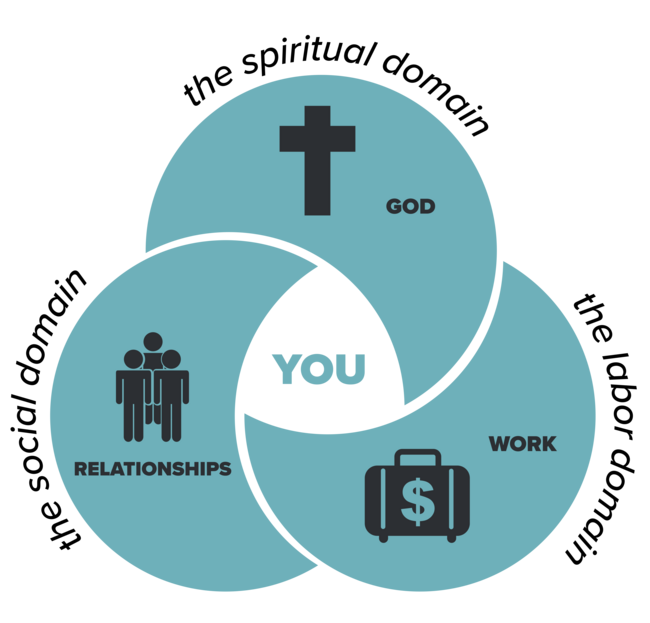
These three areas are fundamental to who we are and how God calls us to live. But because we have limited time, when one area expands and begins to consume more time and energy, it can do so only because you have contracted another area. It’s impossible for finite human beings to add an additional hour to your day to make up for that hour being used elsewhere.
Often without even realizing it, the demands and temptation of work gradually begin to consume more and more of our time, and, as they do, we are left with less time for family. Likewise, as your commitment to career expands, you will inevitably have little time left to do anything but casually attend church.
Almost no one would say, at least publicly, “Work is a greater priority to me than family, so I am going to spend less time investing in my family.” Few believers would declare (or even believe) that career is more important than their relationship with God and his people, yet many of us actively live in this way.
It is impossible for one area of my life to expand without it causing other areas to shrink.
You Are Not Your Job
When dealing with the limits of time, the most practical solution would seem to be better time management, right? If we can just rearrange our schedules and block off an equal amount of time for each domain, the problem should be solved! But human beings are not robots or calendars. We are worshippers. Only addressing time management overlooks causality—that is, heart motivation behind why so many of us have expanded our labor domain to a harmful size at the expense of the others.
Why are so many of us so driven to an unhealthy degree when it comes to our careers? Why are so many of us invested in our job to the detriment of family and church involvement? In a word: identity.
Vertical identity in Christ should free us from looking for identity horizontally anywhere else. I am what I am and who I am because of who Jesus is for me by grace. In his awesome glory, I really do find everything I need. I do not have to look elsewhere for the spiritual resources I need for living. I do not have to hunt elsewhere for meaning and purpose for my life. I do not have to look elsewhere to find that inner sense of peace and well-being. Why? Because I have found all those things in him. Identity in Christ liberates me from a life-distorting bondage to identity in anything else.
But identity amnesia will leave you with an identity vacuum that you will fill with something in your life. If you forget that you are God’s blood-bought child, because work and career form such a huge and significant dimension of our lives, it becomes very tempting for us to look for our identity in those places. Once you start to look to work for your identity, you will find it very hard to resist its challenges, demands, and promises of reward.
The False Identities of Work
Work and career offer you two false but tempting identities. The first is, “I am what I have accomplished.” Success makes you feel able and competent. A trail of achievement seems to make a statement about who you are and what you can do. We generally celebrate successful people as our personal and cultural heroes. We tend to see success always as a good thing.
But what does the true gospel declare and promise? “By grace you have been saved through faith. And this is not your own doing; it is the gift of God, not a result of works, so that no one may boast” (Ephesians 2:8–9).
God’s grace offers you what you did not earn and forgives you for the wrongs you actually did. Grace radically alters your identity and your hope. Your identity is not in what you have achieved or in what the people around you think of what you have achieved. No, as a result of grace, your identity is rooted in the achievements of another. Your hope is based not on how well you are doing but on what Jesus has done for you.
The second false but tempting identity is, “I am the size of the pile of stuff I have accumulated.” Because God has given us the capacity to recognize and enjoy beauty, it is tempting to identify the “good life” as a life filled with beautiful things, which is often the result of a successful career and high-earning job. Of course, the desire for beauty and possessions is not evil in itself. In fact, when I appreciate beauty, I mirror the Creator, whose artistic hand is the source of everything beautiful. I am designed to enjoy beautiful things, but I must not attach my identity to how many of those things I possess, and I must not let my heart be ruled by them.
“Do not lay up for yourselves treasures on earth, where moth and rust destroy and where thieves break in and steal, but lay up for yourselves treasures in heaven, where neither moth nor rust destroys and where thieves do not break in and steal. For where your treasure is, there your heart will be also” (Matthew 6:19-21).
If you have attached your identity to material possessions and physical affluence, you will spend the bulk of your waking hours seeking to acquire them, use them, and preserve them. Only when you are living securely out of your identity as a child of the One who created and owns everything will you be able to rest as his child in the knowledge that he will faithfully provide every good thing that you need. When you are satisfied in him, you will be liberated from working constantly in order to possess more of what you hope will form your identity.
A Career Shaped by Christ
There are several biblical truths that can remind you of your identity in Christ and protect your heart from chasing after the empty promises and temptations of finding your identity in work.
1. The gifts that you employ and the time that you invest in your work come from and belong to God.
“As each has received a gift, use it to serve one another, as good stewards of God's varied grace” (1 Peter 4:10). Just like the grace of salvation is a gift, so are the talents that you possess which make you successful and good at your job. Work is a regular place where God calls you to be a good steward of the gifts, opportunities, and abilities he has given you. Since God has given you these gifts, you must exercise them in submission to his will and for the sake of his glory.
2. You are called to work for something bigger than yourself.
“For the love of Christ controls us, because we have concluded this: that one has died for all, therefore all have died; and he died for all, that those who live might no longer live for themselves but for him who for their sake died and was raised … Therefore, if anyone is in Christ, he is a new creation … Therefore, we are ambassadors for Christ, God making his appeal through us” (2 Corinthians 5:14-15, 17, 20).
By grace, God has liberated me from my bondage to me, which results in death. Instead, he invites us into new life, connecting us to a mission that is huge and eternal. Your life and work are now enormously bigger than merely building a successful career. What I want and what I own on earth should not be the principal motivators of what I do and how I spend my time.
The choices and investment I make in my world of work must always submit to the reality that I have been enlisted to the service of an eternal kingdom that is not my own. Success is not about how well I have been able to build my own little kingdom but about the degree to which I have done all I have done in the service of a greater King.
3. Success is not about accruing power but about resting in Christ’s power.
“That the God of our Lord Jesus Christ, the Father of glory, may give you the Spirit of wisdom and of revelation in the knowledge of him, having the eyes of your hearts enlightened, that you may know what is the hope to which he has called you, what are the riches of his glorious inheritance in the saints, and what is the immeasurable greatness of his power toward us who believe, according to the working of his great might that he worked in Christ when he raised him from the dead and seated him at his right hand in the heavenly places, far above all rule and authority and power and dominion, and above every name that is named, not only in this age but also in the one to come” (Ephesians 1:17-21).
Success in this life is not defined by using your skills, gifts, and career ambitions to create personal power and control. Wisdom, knowledge, riches, and hope come when you recognize and rest in Christ’s power and control, use your gifts for his purpose, and appropriately steward any power that comes your way from God.
Whatever power you may be given is not independent power to use however you wish to use it. All human power is representative. Any power God grants you must be used consistently with the values he makes clear in his Word.
Is Your Triad Balanced?
God will never call you to obey him in one domain in a way that will necessitate sinning in another. In other words, God will never call you to a career that makes biblical commitments to family and church impossible. If it seems impossible to balance your life of work, you are in such a situation not because God’s calls are unmanageable but probably because you are seeking from your work that which you should not.
Many of our work lives are out of balance because of misplaced identity and gospel amnesia. Identity in Christ allows us to rest in the security that we will find everything we need in him. Preaching the gospel to ourselves will allow our domain of work to now be an expression of rest and not worry, stewardship and not acquisition.
Yes, you should be committed to work because God calls you to labor, but as you work, you can rest in his covenantal commitment to meet every one of your needs. Rather than being driven by anxious need, our work can now be shaped by worshipful gratitude.
God bless,
Paul David Tripp